
 Buy Online



How to choose safe sunscreen?
Sunscreen cosmetics are essential in daily skincare throughout all 12 months of the year, not only in summer. They protect against harmful UV rays, which are the first and main cause of premature aging of the epidermis. However, some products have healthier cosmetic formulas than others, which can lead to skin problems – irritation, inflammation or acne. But if no sun-protection care is used at all, the risk is even more serious.
How can we choose products that provide the best protection from harmful sun rays while also carrying the lowest risk of environmental pollution? Their composition is just as important as the sun protection factor.
In the USA, for example, sunscreen products are not ordinary cosmetics but medical products, because they protect the skin from health problems – burns or malignant growths. The production of sunscreen products is strictly regulated by law, and it is very difficult for manufacturers to include new components in sunscreen products. In 2019, the U.S. Food and Drug Administration (FDA) published a study according to which some sunscreen ingredients can be absorbed by the body and enter the bloodstream. In 2020, a new study was also presented, showing that six active ingredients in some sunscreen products are “systemically absorbed” into the blood. These ingredients are avobenzone, oxybenzone, octocrylene, homosalate, octisalate and octinoxate. The European Commission, for its part, also published opinions on some UV filters, including homosalate and octocrylene, which are not safe.
What are these ingredients?
Homosalate
Homosalate is a UV filter widely used in sunscreen products. It has been found that homosalate penetrates the skin, disrupts hormones and over time may produce toxic by-products.
Octocrylene
Studies have found that octocrylene causes a relatively high number of skin allergies. The European Commission recently concluded that there is some evidence of octocrylene’s potential to disrupt the endocrine system.
Healthy, intensive and safe tanning
The U.S. Food and Drug Administration recommends the use of only two filters that are safe and effective – titanium dioxide and zinc oxide. Both components are mineral-based and act as physical blockers. They reflect and repel ultraviolet rays, preventing them from penetrating the deeper layers of the skin. Titanium dioxide and zinc oxide are mineral-based rather than chemical compounds and do not cause skin irritation. They are safe for consumers and do not harm the environment.
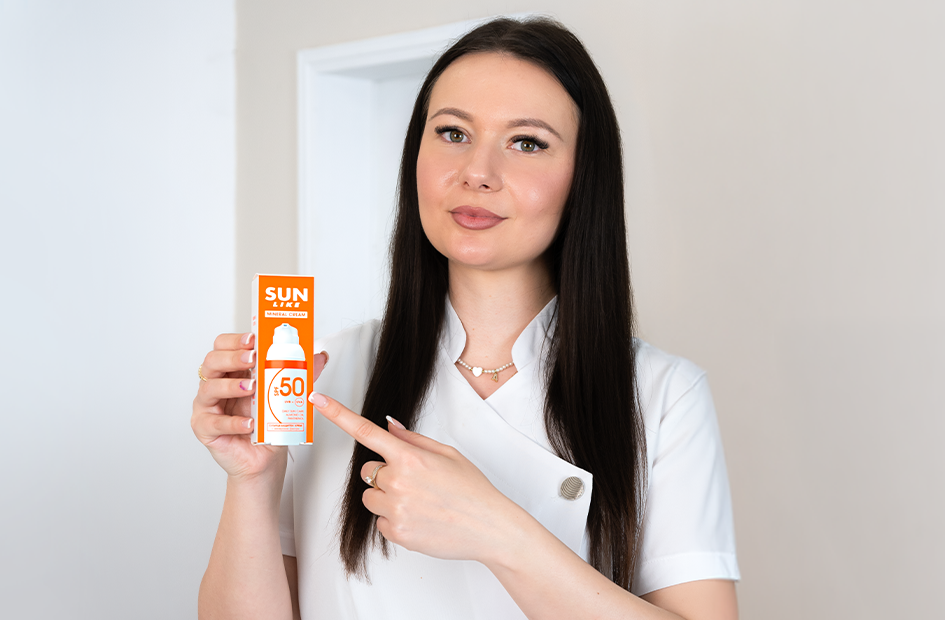
Guided by its mission for human health and the sustainable development of the planet, the “Sun Like” brand followed all recommendations of leading health organizations and for Summer 2022 offers a new, safe and reliable protective formula for its sunscreen range.
“Sun Like” products feature gentle, broad-spectrum UVA+UVB filters. They act immediately after application by reflecting light like a mirror and working on the surface of the skin without penetrating deeply. The new filters provide immediate, safe, reliable and very high protection.
The texture is enriched with Beta Carotene and Vitamin E. It not only protects but also nourishes the skin. Beta Carotene is a provitamin and a source of natural vitamin A; it is also a powerful antioxidant that helps achieve a fast, even and long-lasting tan.
Vitamin E is fat-soluble and provides the extremely important hydration the skin needs. It helps retain moisture and keeps the epidermis nourished and elastic. The combination of vitamins A and E reduces premature skin aging, nourishes and deeply hydrates, and protects against dryness.

The sunscreen products contain panthenol – another effective moisturizer. Thanks to its soothing action, panthenol is an excellent component in the care of irritated skin. It effectively promotes cell renewal and strengthens the natural protective layer of the epidermis. It reduces the feeling of tight skin and stimulates natural tanning.
The products are enriched with hyaluronic acid – it maintains a fresh and radiant appearance of the skin, preserves hydration and accelerates the regeneration process.
The new “Sun Like” sunscreen formula is paraben-free, free from octocrylene and homosalate – filters that were declared by the EC to be unsafe for the body.
What is more, the “Sun Like” sunscreen range comes in climate-neutral packaging with a significantly lower carbon footprint. We used the most modern technology in Europe, developed on the basis of fully recyclable bio-based and certified cardboard. Plastic has been reduced by 48% compared with existing solutions, and the caps are eco slim and contain 50 out of 100 less plastic.
The green philosophy also applies to the packaging of children’s sunscreen products, as well as to the “Sun Like” cooling after-sun gel lotion. The “Green Leaf” tubes are made from 100% recyclable material certified by the Association of Plastic Recyclers. It is suitable for reuse in production without residue.
In addition, they are fully recyclable – that is, ready for a second life after processing.
Dermatologists recommend paying attention to the following qualities when choosing a sunscreen product:
- Broad-spectrum ultraviolet A and ultraviolet B (UVA/UVB) protection.
- Water resistance of the product for at least 80 minutes.
- Mineral ingredients – titanium dioxide and zinc oxide.
- Sun protection factor of at least SPF 30.
- Sunscreen should be applied to all exposed parts of the body, daily during the warm months, regardless of weather conditions.
- At the beach, in warm weather or when sweating, reapplication of sunscreen every two to three hours is recommended.
- Start every new season with a new sunscreen product.
Author: Desislava Frangova


